ワリッキーvs. ミズスギナ いままでとこれから
アクアリウムにおけるロタラ ワリッキーとその周辺は、かなり混沌としている。
同じようで少し違ったり、全く区別がつかなかったりする様々な輪生のキカシグサ属が流通しているためである。
その中で、どれがどの種に相当するかは極めて難しい問題である。
アクアリウムにおいてはじめに世間の目に晒されたこの類は、現在単に「ワリッキー」だとか「リスノシッポ」として流通する、沈水葉に赤みの強い個体群である。
ロタラ ワリッキー(水上葉)(無農薬)(10本) | チャーム
↑いわゆる「リスノシッポ」。葉はこの類で最も細く、かつ最も赤い。
【水生植物】 リスノシッポ (ロタラ ワリッキー) | 杜若園芸WEBショップ|水草の生産販売【通販ショップ】
↑花弁はピンク色で、非常に大きく発達する。
この個体は水中では茎はあまり色づかないものの沈水葉が先端にかけて紅色~ピンク色に強く赤くなり、陸上葉はやや先端に欠けて丸みを帯び、他の個体と比べると青色がかった色合いをもつ植物で、非常に美しいものの栽培はやや気難しい。
その後ワリッキーといえばこのリスノシッポで、そだてにくい水草の代表格でもあり続けたのだが…
次にアクアリウムで日の目を浴びたのは、「ナンセアン」だろう。
ロタラ ナンセアン(水上葉)(無農薬)(10本) | チャーム
↑抽水葉、沈水葉ともにリスノシッポより明らかに幅広である。
【水生植物】ロタラナンセアン | 杜若園芸WEBショップ|水草の生産販売【通販ショップ】
↑ピンク色の花がみられる。花弁はリスノシッポより明らかに小さい。
これは台湾でいうところの南仁節節菜で、台湾の南仁湖周囲から知られている謎の不稔植物である。トリミング耐性が強く適度に横に伸びることから水草レイアウトで流行した。現在ではなぜかあまり見かけなくなってしまったが、レイアウトにお勧めしたい水草の上位に入るだろう。台湾にはR. wallichiiが分布するというが、ほぼこの南仁節節菜であるようで、ほかには一部にR. hippurisがいるともいう。
台湾便ロタラ・‘プシラ’1鉢 | water plants lover
ロタラ プシラ 台湾便(水上葉)(無農薬)(10本) | チャーム
ちなみに、これの兄弟分のような水草の”プシラ台湾便”はそっくりだがトリミングに弱く、直線的に成長する。抽水条件で開花した際は花弁の大きさや草体などはそっくりだが花がナンセアンよりだいぶ白っぽかった覚えがある(今度咲いたときに、よく観察せねば。)ちなみにプシラは全く別の植物。花弁がある時点でプシラではありえない。
さて、その後ワイルド水草ブームでベトナムやカンボジアなどから様々な「ワリッキー系」とでもいうべき水草が輸入されてくると話が変わってきた。
ロタラsp.ベトナム レッド(水上葉)(無農薬)(10本) | チャーム
ロタラsp.カンボジア産(水上葉)(無農薬)(10本) | チャーム
これらはいままでのワリッキーと比べると大型で、葉は黄色~オレンジ系に一様に色づき、茎が強いオレンジ色に染まる。また、リスノシッポやミズスギナと比べると嘘のように栽培が簡単で、成長も速い。一見したところミズスギナに似ていることや、条件によっては閉鎖花をつけたりもすることからリスノシッポとはだいぶ違う植物のようにも思われ、「ミズスギナ系」と形容されたりもした。
但しこれがミズスギナなのか、ワリッキーなのかは、現時点では釈然としないように思われる…というのが今回の記事の後半戦となる。
その後、”ボッシー”、”メキシカーナ”、”ワリッキー”などなど…様々な名前がついて、こうした”だいたい同じ”オレンジ系の細葉ロタラが輸入されてきて、市場はたいへんカオスなありさまとなっている。
その中でも時には、変なものが入っている。
ロタラsp. ‘バングラデシュ’ ADAみずくさの森 | Ordinary-Aquarium
国内便ロタラsp.‘バングラデシュ’1鉢 | water plants lover
【水生植物】 ロタラsp.バングラデシュ | 杜若園芸WEBショップ|水草の生産販売【通販ショップ】
ロタラsp `バングラデシュ‘は沈水葉と陸上葉で殆ど数が変わらず、上記の3タイプのどれにも該当しないように見える。第四の細葉系ロタラと言っていいと思う。
ほかにも細いロタラはR. mexicana(旧R. pusilla)に属するいくつかと、最近ではR. occultifloraがアクアリウムでは栽培されているが、これらは基本的に一年草の両生植物であって、上記に挙げたような多年生の沈水植物とはだいぶ趣が異なる。
さて、アクアリウムからいったん離れよう。
西欧の人々にとってはじめて目に触れたアジアの沈水性ロタラもまた、R. wallichiiであった。
アジアにおいてこの手のロタラに初めて名をつけたのはJoseph Dalton Hooker(1817-1911)である。彼はミャンマーのダウェイ(Dawei, 当時Tavoyとよばれた)においてWilliam Gomez が採集した標本(#9059)に対し、新属新種としてHydrolythrum wallichiiの名を与えている。
ホロタイプ
wallichiiという名はカルカッタ植物園の設立に関与したデンマーク人の外科、植物学者であるNathaniel Wallichにちなんでいる。
https://en.wikipedia.org/wiki/Nathaniel_Wallich
採集者のWilliam Gomezはカルカッタ植物園の植物ハンターであり、Wallichによりリクルートされたらしい。
H. wallichiiの原記載を貼っておく。
v.1:pt.3 (1867) - Genera plantarum - Biodiversity Heritage Library
(p.777)
この記載には図がないが、その後Hookerは本種の精巧な図を残している。
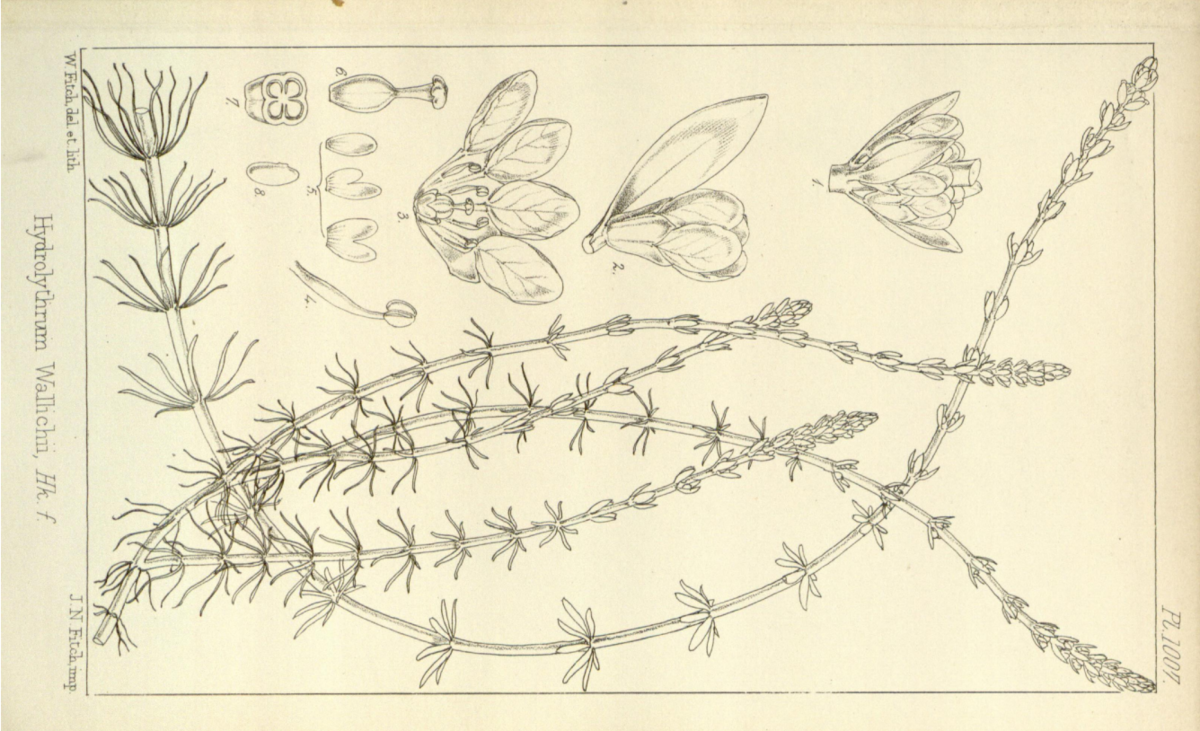
花弁がかなり大型であること、二分岐した蜜腺があることなど、特徴がよくみてとれる。
その後、Wilhelm Sulpiz Kurzは本種をAmmannia属と考え、
v.46:pt.2 (1877) - Journal of the Asiatic Society of Bengal - Biodiversity Heritage Library
その後Bernhard Adalbert KoehneがRotala属に移している。
さて、日本では1898年に牧野富太郎がミズスギナを記載している。
https://doi.org/10.15281/jplantres1887.12.77
彼はミズスギナとワリッキーに対し、こう言及している…
This species is closely allied to the already known Rotala Wallichii Koehne
(= Hydrolythrum Wallichii Hook, fil. ; Ammannia Wallichii Kurz) of British India, and judging from the descriptions of the latter by Hooker and Koehne, my species seems not to be conspecific with it.
It has the habit of Hippuris vulgaris Linn.
さて、その後長い時間を経て、Christopher David Kentish Cookは1979年に”A revision of the genus Rotala (Lythraceae)”でキカシグサ属を再度まとめなおしている。
ここではR. wallichiiとR. hippurisの違いを「R. wallichiiは花がより大きく(萼筒1.5㎜、花弁2.5㎜)、閉鎖花を作らず、蒴果は萼筒の中に収まる」(Like R. hippuris but flowers larger (calyx tube c. 1.5 mm long, petals c.2.5 mm long) and not cleistogamous, capsule remaining within the calyx tube.)としている。
しかしながら、読み直してみるとこの記述にはかなり気になる要素がある。
CookはR. wallichiiとアフリカのR. myriophylloidesを栽培しており、記述に際してそれらの栽培条件での挙動も加えて書いている一方で、ミズスギナに関しては標本をもとに記述している点には注意が必要である。さらに、Cookは栽培下においてR. wallichiiを結実させることができず、(自家不和合性が強く、人工授粉しても結実しなかったと)さらに標本においても完熟した果実や種子を確認することはできていない。つまり、完熟時の果実や種子による両者の比較は困難である。ミズスギナのように、熟した蒴果が萼筒を突き破る現象が絶対に起きないかと言われれば、証拠不十分に思わせられてならない。
さらにCookのいうミズスギナの花弁は実物からすると不自然に小さいように思われ、標本にする際の問題もあるかもしれない。
さらにミズスギナの蜜腺に関して、Cookは図示していないし記述もしていないのだが、牧野は図示していないものの記述はしている点にも注意が必要だ。のちのSivarajan & Joseph (1988)では両種によく似たR. cookiiを記載しているが、ここではミズスギナには蜜腺がない、ように書いている(It(R. cookii) also resembles R. hippuris, a Japanese endemic, but is quite distinct in having nectar scales. ).
ここで、R. wallichii, R. hippuris, R. cookiiの形質を簡便に表にまとめてみる。
|
|
R. wallichii |
ミズスギナ R. hippuris |
R. cookii |
|
生態 |
Aquatic or amphibious perennial. |
Aquatic (or amphibious )perennial.
|
Aquatic annual, often submerged.
|
|
|
Stems creeping, rooting and branched below, floating or erect and usually simple above, up to 30 cm or more long. |
Stems creeping and rooting below, floating, ascending or erect above, up to 30 cm or more long.
|
Stem up to 40 cm long, creeping and rooting below, branched from base.
|
|
輪生数 (沈水) |
Leaves in whorls of up to 20 or more |
Leaves in whorls of 5-12 or perhaps more
|
Leaves in whorls of 7-10
|
|
沈水葉 |
Linear or capillary, thin, translucent, tinged with red, up to 20 mm long |
capillary 20-30 mm long,
|
capillary, often reflexed, up to 15 mm long |
|
沈水葉の先端 |
at apex bifid |
at apex microscopically bimucronate
|
microsopically bimucronate at apex
|
|
輪生数 (抽水) |
in whorls of 3-12 (less than submerged leaves) or rarely decussate, linear to oblong, |
記載なし 原記載:5~12(下部9~12、上部5~6)
|
7-10 (almost equal number of leaves in the submerged and emergent whorls)
|
|
|
rarely more than 5 mm long
at base scarcely narrowed |
s linear, 5-10 mm long, 0.7-1 mm wide at base scarcely narrowed.
|
spreading, linear, 5-6 mm long, 0.6-0.8 mm wide, , narrowed towards base. |
|
|
apex obtuse or bifid. |
obtusely truncate to obscurely bimucronate |
bimucronate at apex |
|
苞 |
like aerial leaves, oblong to ovate, 1.5-3 mm long, at apex acute or bifid |
leaf-like, either submerged or aerial
|
leaf-like |
|
小苞 |
capillary up to 0.5 mm long |
bracteoles linear, shorter than calyx tube
|
bracteoles linear, c. 0.5 mm long, shorter than the calyx tube, persistant in fruit.
|
|
花 |
monomorphic, solitary, several at each internode, shortly pedicellate; pedicel adnate to bract, combined organ up to 1 mm long |
monomorphic, sessile, solitary, rarely more than 2 at any internode* fertile internodes somewhat erratic, borne on submerged and aerial shoots;
* 標本の問題? |
on submerged shoot cleistogamous, those on emergent branches normal, sessile, usually 2-4 per node. |
|
閉鎖花 |
観察無し
|
submerged flowers cleistogamous with reduced petals and calyx lobes. |
|
|
萼筒 |
campanulate, membranous, translucent, c. 1.5 mm long |
campanulate, 0.7-1 mm long |
Campanulate, 0.7-1 mm long, transluscent. |
|
萼筒(成熟時) |
観察無し
|
splitting and disintegrating as the fruit ripens |
splitting and disintegrating as the fruit ripens |
|
萼片 |
4. deltate, c. 0.5 mm long. |
calyx lobes 4. deltate, 0.2-0.3 mm long or less in cleistogamous flowers. |
lobes 4, deltate, 0.4-0.5ram long. |
|
花弁 |
4, obovate, showy, pink (or white?), c. 2.5 mm long |
Petals 4, obovate 0.2-0.6 mm long, rudimentary in cleistogamous flowers. *0.2-0.6㎜は標本の問題だが、1㎜前後で2㎜を超えない |
Petals 4, obovate-obtuse, white, alternating with calyx lobes, 0.7-0.8 mm long. |
|
|
Petal>Calyx |
Petal<Calyx *標本の問題? |
|
|
雄蕊 |
4, inserted below the middle of the calyx tube |
4, inserted on lower half of calyx tube |
4, inserted on the lower half of calyx tube, filaments white, 0.6-0.7 mm long, |
|
|
anthers borne level with the top of the calyx lobes |
anthers not exceeding the calyx |
anthers borne level with the base of petals. |
|
蜜腺(Nectar scales) |
bilobed |
*** Joseph & Sivarajan, 1987では持たないとされているが、 原記載に記述あり Hypogynous-nectaries 4 or 5 , f ree or some of them connate at the base, thick, squamaeform, roundedobtuse, darkish-red, surrounded the base of ovary |
4, small greenish yellow or pink, minute, broader than long, apex mostly obtuse or truncate. |
|
雌蕊 |
Ovary globose style c. 0.5 mm stigma capitate |
Ovary globose; style very short; stigma capitate
|
Ovary globose, 0.6ram long; style simple, short, persistant on fruit. Stigma capitate, minutely papillose. |
|
蒴果 |
globose, c. 1 mm diam*., opening by 2 valves remaining within the calyx tube*
|
globose, up to 1.5 mm diam, opening by 2 valves
|
globose up to 1.2 mm across, opening by valves. |
|
種子 |
semi-ovoid, c. 0.7 mm long*
|
seeds semi-ellipsoidal, c. 0.6 mm long.
|
Seeds 4-5, semi-ellipsoidal, up to 0.9 × 0.6 ram. |
|
|
|
|
|
|
その他 |
size of capsule and seeds may be underestimated as I have not seen really ripe material |
原記載 judging from the descriptions of the latter by Hooker and Koehne, my species seems not to be conspecific with it. It has the habit of Hippuris vulgaris Linn. |
|
さて、Cook以降にワリッキーとミズスギナを本気で比較した文献がイマイチ見当たらないのだが、肝心のCookのモノグラフがこの問題を解決するにはいまいち力不足であるように思えてならないし、牧野の書き残したメモもなんというか、何となくな感が否めない(seemsとか書いているし…)。
すくなくとも、ワリッキーの開放花がミズスギナより大きいことに関してはCookの指摘した通り間違いないのだろうし、ミズスギナが自家受粉することも栽培下においてよくみられることから、ワリッキーと異なりミズスギナが自殖性であることは言えるのだろう…とは思う。しかし、へたするとCookの株は別の理由で不稔であった…可能性すら否定しがたい。
この問題は未解決事件に相当するもののように思われる。
両者の蜜腺を生の状態で比較したり、しっかりと結実し完熟したR. wallichiiの果実を観察したり(誰も記述していないのではないか)、閉鎖花を作る”ミズスギナタイプ”の植物の花の大きさがどうであるか観察したり(こんな面倒な状況だと知る前に見たことがあるものではワリッキー型だった覚えがあるが、あらためて見なければならない)、自家不和合性と書いてあるが、本当にそうなのか検証したり…
やるべきことは沢山あるだろう。野外にミズスギナ「系」ロタラが出現する前に形質での見分け方が確立されてほしいと切に願っている。
身近な水草の足元に広がる谷地眼は、ときに信じがたいほど深い。
あ、ナンセアンとR. cookiiに関して触れるのを忘れた。
